History
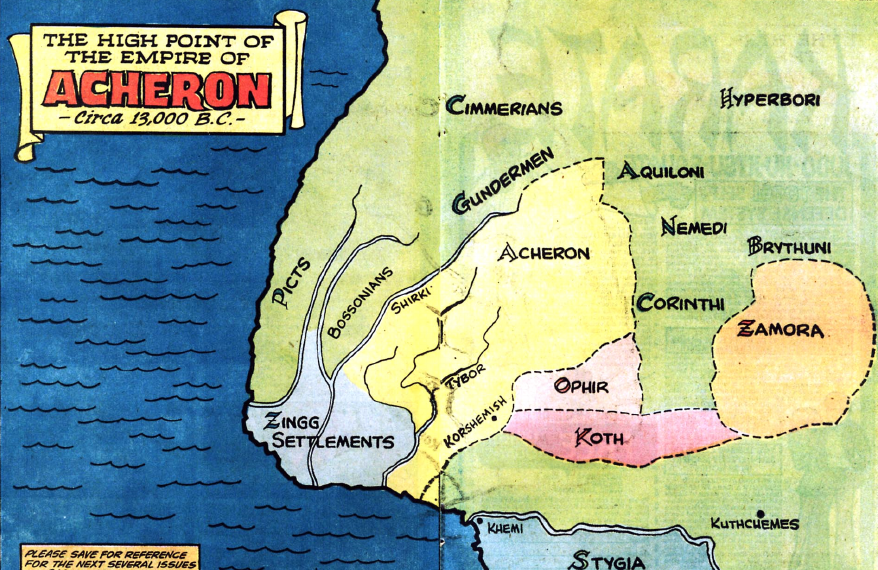

"The High Point of the Empire of Acheron", circa 13,000 BC
Origins
By the first Hyborian southward push, Brythunia was a virtually uninhabited land.[1]
By the first Hyborian southward push, Brythunia was a virtually uninhabited land.[1] The Brythuni, following a bit later after the Corinthi who set themselves between Zamora and Acheron, were tributary of Zamora, were under Zamorian influence.[7] By the end of the Age of Acheron, circa 13,000 BC, the Brythuni were one of the many Hybori tribes dwelling north- and eastwards of Acheron, the Brythuni themselves being set northwards of Zamora and eastwards of the Nemedi and of the Corinthi.[8]
After the kingdom of Koth took its independence from Acheron, King Khossus V of Koth formed a grand alliance of all enemies of Acheron, including Koth, Ophir, the Corinthi, the Brythuni, and others, and marched on the Acheronian capital of Python from the east.[9]
After the Fall of Acheron, Acheronian refugees established city-states in Brythunia, as did refugees of Hyperborea the Elder. Flourishing, the Brythunians moved southwards and mingled with the ancient people of Zamora, as well as with invading Hybori.[1] After the kingdom of Koth took its independence from Acheron, King Khossus V of Koth formed a grand alliance of all enemies of Acheron, including Koth, Ophir, the Corinthi, the Brythuni, and others, and marched on the Acheronian capital of Python from the east.[9]
After the Fall of Acheron, Acheronian refugees established city-states in Brythunia, as did refugees of Hyperborea the Elder. Flourishing, the Brythunians moved southwards and mingled with the ancient people of Zamora, as well as with invading Hybori.[1]
Age of Conan
War with Tomar of Hyperborea
At Ravenplain, King Brian of Charnina[10] and King Tomar, a warlord[11] and an ambitious under-king of Hyperborea.[12] Brian was betrayed by Malachi, commander of the Brythunian Cavalry, who was the lover of Queen Kormlada, wife to King Tomar. Malachi agreed to hold back his horsemen to assure Brian's defeat. During the battle, King Brian remained at his tent, while 20,000 Brythunians clashed with an equal number of Hyperboreans. As Conan of Cimmeria, who fought along the Brythunians, was ravaging his army, Tomar fled the battle and managed to enter Brian's tent, and the two kings slew one another. This battle was the last in which Bori's Choosers of the Slain came to collect the fallen, as Bori, the Grey God, withdrew from Earth as his last worshipers died.[11] Brian's death caused Charnina to be torn between the factions of Lord Pollus and Lord Ludox.[10]
Afterwards, Conan tried to pass to Zamora. Wounded, he was helped by Ahirn and his family, until they were all killed by a band of Zamoran slavers. After killing the slavers, he kept on on his attempt to reach Zamora.[13] In the process, he met Skalla, a Chooser of the Slain who wished to stay among the mortals, but eventually returned to Father Borri. After she left, the Cimmerian resumed his efforts to climb the pass to Zamora.[14]
War and Peace with "Nemedia"
"Belverus" was a city-state in Brythunia, ruled by outcast Nemedians, and obviously named after Belverus, the actual capital of Nemedia.[15] During the rule of Empress Auraldia, General Conan led the Nemedian legions into subjugating Brythunia.[16] At least part of Brythunia, including the Lema Plains, remained under Nemedian control for at least a decade. After four years of Emperor Vadalia's rule, the Nemedians stopped the annual Hypeborean invasion coming from the Graaskal Mountains, following the harvest, and Brythunia's northern border was in peace. The Brythunians still resented the Nemedians though.[17] The Nemedian eventually withdrew, notably in Southern Brythunia, where the massive man-powered irrigation structure known as the Wheel was left behind, only for Lord Thoyaga to take control of it.[18]
End of the Hyborian Age
Following the collapse of the Aquilonian Empire, the Hyrkanians and Turanians united. They swept over Zamora,[19] then poured into Brythunia through the many passes of the northeastern highlands[1] (while also invading Hyperborea and Corinthia.[19]
Pushed by the Nordics, the Cimmerians successively destroyed Gunderland, defeated the half-civilized Nordic-Nemedians and sacked some of the cities of Nemedia, and defeated an Hyrkanian army at the border of Brythunia. As the Aesir and Vanir pushed southwards against the Pictish Empire, Nemedia was overthrown and the Nemedian-Nordics fled to Shem, Hyperborea and Brythunia, where they broke the back of the Hyrkanians, forcing them back toward the Vilayet Sea.[19]
Aesir still living in Aesgaard after the Age of Conan were eventually forced to flee their nation due to the encroaching glaciers. They swarmed into Brythunia and became known as Brythons or Britons,[20] mixing with Brythunians,[21] while other Hyborian lineage nearly disappeared. The western world was ruled by Nordic barbarians.[19]
After the Hyborian Age
Millenia later, the land of Brythunia became the lands of the aristocrats of Poland,[1][21] and modern Poland approximates Brythunia.[22]
Facts
Politics
Brythunia was one the Hyborian Kingdoms, though not a very unified one. A single monarch maintained nominal authority over a large number of autonomous cities and noble domains. The nobility in fact prided itself in being able to restrict royal authority. Brythunians had long tried to establish their country was a regional power, but their lack of unity left them overshadowed by the better-organized Aquilonia and Nemedia.[2]
Language
The Brythunic tongue was essentially Hyborian roots adapted to Zamorian inflections.[7]
People
The lineage of the Brythunians is a complex one, and was said to be an admixture of refugees from Hyperborea the Elder, Acheron, completed later by Hyborian invaders and by Zamorians, but lacked aboriginal genes.[1]
For some reason, the Brythunians were frequent subjects of Hyborian jokes. Their men had been stereotyped as "thickwitted oafs."[2]
On the other hand, their women had a reputation for beauty and sensuality. The women were prized items for slave traders, since this reputation ensured that there were always customers willing to pay high prices for them.[2]Points of Interest
- Northern Brythunia
- Lema Plains - Northwestern region
- Aradath - City-state
- Demon's Teeth
- Ravenplain/Ravenfield - site of a battle between King Brian of Brythunia and King Tomar of Hyperborea
- Graaskal Mountains - Mountains forming the border with Hyperborea
- Hyperborean Wall - Massive wall in the Graaskal Mountains, built by "the elders" in the time before Man
- Lema Plains - Northwestern region
- Kelbaza - City-state[2]
- Berthalia - City-state
- Charnina/Chamina - City-state
- Ketra - Province
- Pirogia - Capital of Ketra, walled city-state
- Potrebia/Pothrebia - largest walled city-state of Brythunia, resting place of the bones of the Prophet of Mitra
- Great Temple of Mitra
- Partephanos - City
- Eridu[23]
- Southern Brythunia
- The Wheel - Man-powered irrigation system built by the "Nemedians"
- "Nemedia" - Outcast Nemedians-ruled Empire that subjugated most of Brythunia for a time
- "Belverus" - Outcast Nemedians-ruled city-state
- "Numalia"
- "Hanumar"
- Brythunian Mountains - Mountain chain delineating the border with Zamora
- Frozen River - River from Zamora at southeast to the northern border with Hyperborea where it follow the Graaskal Mountains
The northern border, with Hyperborea, was delimitated by the Frozen River,[1][24] the Graaskal Mountains,[5][17][1][25] and the Hyperborean Wall.[17] For a time, part or all of this border was controlled by ""Nemedia".[17]
The western border, with Nemedia, was delineated presumably along a north-flowing river.[1]
The western border, with Zamora, was delineated by the Brythunian Mountains.[13]Residents
Notes
- Brythunia was created by Robert E. Howard, and mentioned in many stories including "The Thing in the Crypt", "The Tower of the Elephant", "Shadows in Moonlight", "Road of Eagles", "The Devil in Iron", "Th Scarlet Citadel", "The Return of Conan", as well as in the pseudo-historical essay "The Hyborian Age".[1]
- Brythunia was conceived as the Hyborian equivalent of Poland,[citation needed] and in-universe, the land of Brythunia became Poland.[1]
See Also
- 25 appearance(s) of Brythunia
- 1 appearance(s) in handbook(s) of Brythunia
- 2 minor appearance(s) of Brythunia
- 62 mention(s) of Brythunia
- 1 mention(s) in handbook(s) of Brythunia
- 1 image(s) of Brythunia
- 10 article(s) related to Brythunia
- 14 citizen(s) of Brythunia
Links and References
References
- ↑ 1.00 1.01 1.02 1.03 1.04 1.05 1.06 1.07 1.08 1.09 1.10 1.11 1.12 Savage Sword of Conan #31 ; A Gazetteer of the Hyborian Age, Part II: Brythunia's entry
- ↑ 2.0 2.1 2.2 2.3 2.4 Handbook of the Conan Universe #1 ; Brythunia's profile
- ↑ Conan the Savage #7
- ↑ Savage Sword of Conan #145 ; Feast of the Stag
- ↑ 5.0 5.1 Savage Sword of Conan #162 ; The Horned God
- ↑ Savage Sword of Conan #148 ; Besieger of Cities's recap
- ↑ 7.0 7.1 Giant-Size Conan #1 ; Acheron: A revisionary theory
- ↑ Giant-Size Conan #1 ; The High Point of the Empire of Acheron
- ↑ 9.0 9.1 Savage Sword of Conan #229 ; Assault on Acheron
- ↑ 10.0 10.1 Conan the Adventurer #3
- ↑ 11.0 11.1 Conan the Barbarian #3 ; The Twilight of the Grim God!
- ↑ Conan Saga #72 ; A Chronology of Conan's Career - Chapter One: "It Takes a Thief...", IV. Civilization - After a Fashion
- ↑ 13.0 13.1 Conan the Adventurer #6
- ↑ Conan the Adventurer #7
- ↑ Conan Saga #84 ; Conan Comics Chronology, Chapter Nine - IV. Brythunian Interlude
- ↑ Savage Sword of Conan #148 ; Besieger of Cities
- ↑ 17.0 17.1 17.2 17.3 Savage Sword of Conan #178 ; Pillar of the Sky
- ↑ Savage Sword of Conan #159 ; The Wheel
- ↑ 19.0 19.1 19.2 19.3 Savage Sword of Conan #17 ; The Hyborian Age - Chapter 6; The Darkness... and the Dawn
- ↑ Savage Sword of Conan #30 ; A Gazetteer of the Hyborian Age: Aesir's entry
- ↑ 21.0 21.1 Blockbusters of the Marvel Universe #1 ; Great Cataclysm's profile
- ↑ Savage Sword of Conan #44 ; Notes on Hyborian Heraldry and Cartography
- ↑ Conan the Barbarian #263
- ↑ Savage Sword of Conan #31 ; A Gazetteer of the Hyborian Age, Part II: Frozen River's entry
- ↑ Savage Sword of Conan #33 ; A Gazetteer of the Hyborian Age, Part III: Graaskal Mountains's entry